

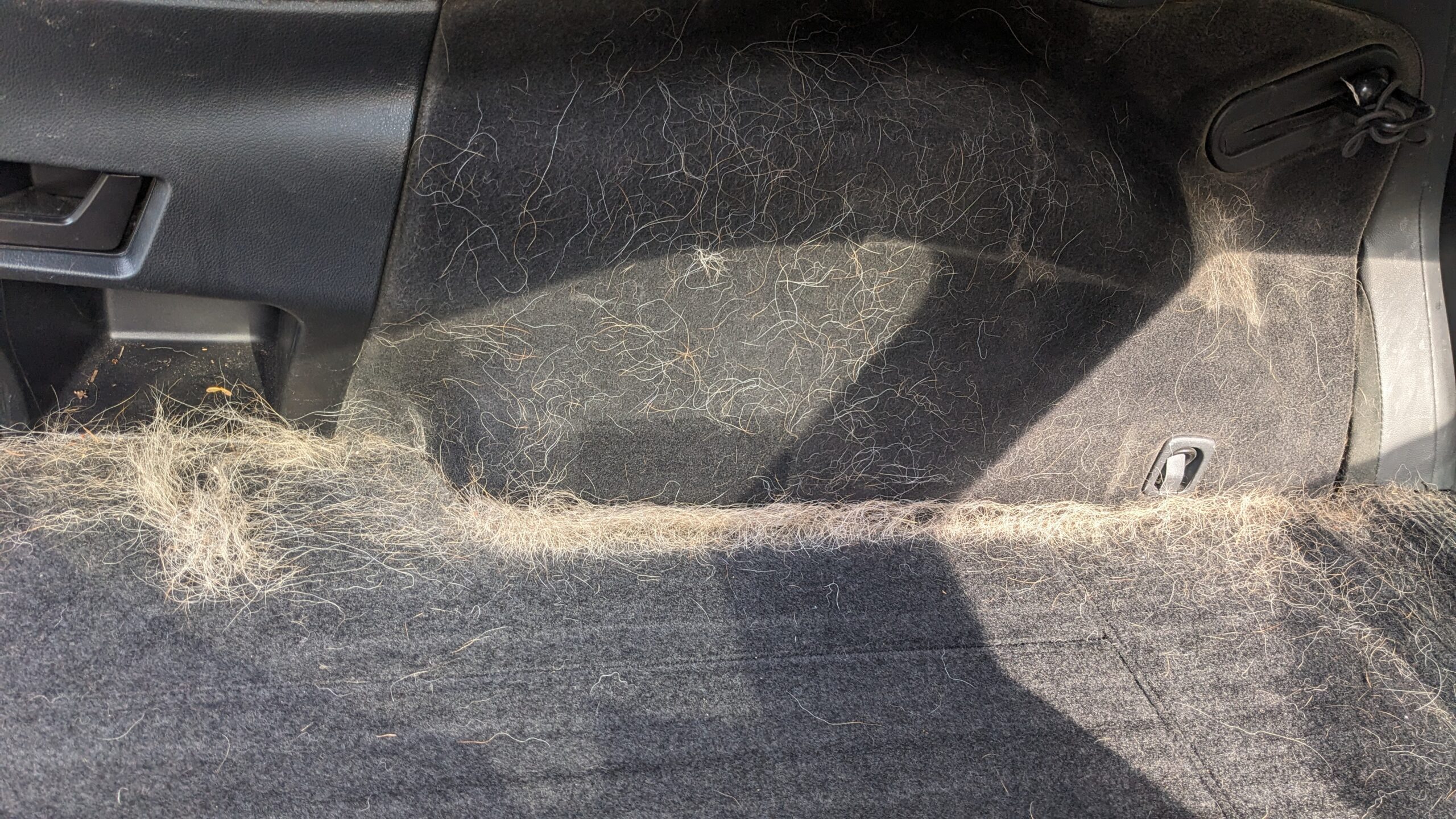
Removing pet hair from your car’s carpet is no easy feat, yet it’s a common problem. A surprising (alleged) statistic is that there are more dogs than human children in Seattle. That means there’s a lot of shedding going on (and that’s not even including our beloved cats), and a fair bit of that shedding ends up in people’s cars.
Many people take their furry friends on road trips to go hiking and camping here in the beautiful Pacific Northwest. But even a quick ride to the park or a trip to the vet can leave pet hair everywhere, and I do mean everywhere.
When you’ve finally had enough of the sight (or smell) and decide to tackle it yourself, using a vacuum or microfiber cloth on surfaces like the dash, plastics, and door panels is pretty straightforward. But when it comes to your vehicle’s carpet, removing pet hair can be a whole different animal.
If you’ve ever tried vacuuming pet hair straight out of carpet, you probably noticed that it doesn’t work very well and most of the hair stays embedded in the fibers. That’s because the key to effective vacuuming is agitation.
That’s why professional detailers often use manual hand brushes, motorized drill brushes, or compressed air tools while vacuuming. The agitation loosens the hair from the carpet fibers so the vacuum can actually remove it. It makes things way easier and removes so much more.
Below are a few different tools that you can try yourself.
Probably Not the Best Option: Lint Rollers

One of the first methods people try is using a lint roller—the same kind you might use on clothing.
While it seems like a good idea at first, in practice it’s usually not very effective for vehicle interior pet hair removal.
For starters, lint rollers don’t tend to pick up as much pet hair as other tools. They may grab some debris, but they lose their stickiness pretty quickly. Cleaning an entire vehicle would require a lot of sheets, which can become wasteful and expensive.
Their shape is also a limitation. Lint rollers struggle to reach tight corners, seams, and awkward angles that are common in car interiors.
While they might work for small touch-ups, they generally aren’t the best option for removing large amounts of pet hair from automotive carpet.
A Good and Convenient Option: Rubber Brushes
A much better option for most people is a rubber or plastic pet hair brush.
These are inexpensive tools that can easily be found online. They come in several variations. Some have a single row of firm rubber teeth that grip hair well, while others have triangular designs with multiple edges for different types of carpet.
They tend to clump hair into a single, easily collectable lump unline lint rollers that just sort of stick to hair straight up and down. Also unlike lint rollers, rubber brushes:
- Don’t require refills
- Lift hair up and out significantly better on thick carpet fibers
- Work around tighter areas and edges better
If you’ve ever used a standard bristle brush on pet hair, you know they can become hopelessly tangled. Rubber brushes, on the other hand, usually have wider spacing between the teeth, which allows hair to collect without clogging the tool.
They’re also durable and can last a long time. Most cost around $10–$20, making them a great tool to keep in your vehicle for whenever you might need to remove pet hair.
Another major advantage is that they’re generally safe if they accidentally touch hard plastics or leather surfaces, making them convenient for quick cleanups. If you keep one in your center console, you can quickly remove pet hair every now and then before it builds up too much.
Best (But Use With Caution): Pumice Stones

As a professional detailer, the tool I personally use when dealing with the most stubborn pet hair is something surprising: a pumice stone, also known as a scouring stick.
It might seem strange at first, but the porous texture of a pumice stone is incredibly effective at grabbing hair embedded in automotive carpet. The hair lifts out of the fibers and can then be easily vacuumed.
With rubber brushes, you often need to apply firm pressure while brushing. A pumice stone can often achieve equal or better results with lighter pressure and fewer passes.
In my experience, a rubber brush can achieve about 90–95% pet hair removal, while a pumice stone can reach 95–98% when used correctly.
A WORD OF CAUTION
These rocky looking rectangles aren’t all sunshine and rainbows. Pumice stones are powerful tools, but they must be used carefully.
They can easily damage interior plastics if they scrape against trim panels. Pumice stones should be used on carpet surfaces and only carpeted surfaces. When you’re working near edges or plastic trim pieces, it’s best to switch to a rubber brush.
Trust me—it’s very tempting to try to remove “just a little more hair” near the edge. But getting too close can leave a permanent scratch or gouge in the plastic. Unfortunately, interior plastic damage can’t really be buffed out like some light scratches on your exterior can.
Using both tools together—a pumice stone for the main carpet area and a rubber brush for edges—is often the safest and most effective approach.
Another thing to watch for is using too much pressure on the actual carpet, especially on older or lower-quality carpet. Pumice stones can create enough friction to pull up carpet’s own fibers if you press too hard. Light strokes are usually all that’s needed to remove pet hair without damaging the carpet with unnecessary wear and tear.
When It Might Be Time for Professional Help
While using these tools yourself can be effective, removing pet hair from a vehicle interior isn’t always quick or easy. It can take time, patience, and a fair amount of effort to get great results.
If pet hair has really built up—or if you just want a fresh reset—it might be time to call in a professional.
Here at Clean Green Machines, we specialize in deep interior detailing and pet hair removal. Whether your car needs a full refresh or just help tackling stubborn fur, we’re happy to help.
Contact us today to schedule a detail, and let us know about your furry co-pilot. We’ll make that pet hair disappear. Check out our interior detailing prices and our interior and exterior prices, and then just add $29 for our pet hair fee!